Posts

WEEK 7: NEUROSCIENCE AND ART
Image
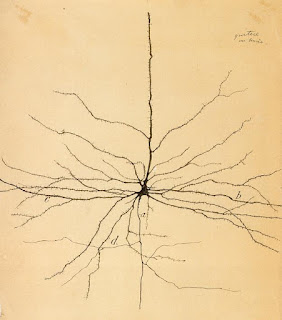
The intersection of art and neuroscience is a very interesting area. Historically, art was needed to study neuroscience. In the 19 th century, microscopy was not very advances, which meant that studying neurons was very difficult. Thus, scientists turned to artists to provide this information so that they could study neurons in more detail. Santiago Ramón y Cajal, the father of modern neuroscience, who was both an artist and a scientist, drew very detailed drawings of neurons and helped this field grow. This was followed by the use of neuroscience to create art. One cool example mentioned in the lecture was Brainbow. Brainbow involved using fluorescent proteins of different colors to light up neurons in order to be able to distinguish individual neurons. Also now, neuroscience is being used to study art. This falls under the field of neuroaesthetics , which specifically explores how and why people appreciate art, music and the very concept of beauty. Semir Zeki and Vilayanu...

EVENT 2: MNEMOWARI BY ELÍ JOTEVA

Image
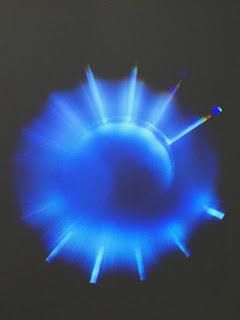
Last week I had the opportunity to attend an exhibition by Elí Joteva titled “Mnemowari”. This is the first art display I have seen and I am quite fascinated by the experience. This exhibition was an interesting play on time, as the displays portrayed the future, present and the past. "Dream-wave" portrait Mnemowari - brief overview The exhibition was divided into four compartments, with the first compartment being a projection of a “dream-wave portrait” on the wall, and represented future. At first, I was quite confused by this. It was very beautiful but I had no context for this display. After seeing the other compartments, I felt that this display was in a way standalone and a bit disjointed. It could be because we know the past and present, but the future is abstract and has infinite possibilities. The second compartment represented the present, and consisted of cryo scultures, which were three balls of ice hanging from the ceiling using rope. Each sc...

WEEK 6: BIOTECHNOLOGY AND ART

Image
Biotechnology, according to the Convention on Biological Diversity, is any technological application that uses living organisms to modify products or processes for specific use. The use of biotechnology in art seems almost inevitable, given how easily technology and robotics have been used in art. More specifically use of genomes in art has been particularly of interest.   George Gessert’s work is a great example of bioart. Gessert created genetic hybrids of irises by hybridizing wild varieties and removing undesirable results. This created unique synthetic breeds of irises that had immense aesthetic beauty. However, this has been a very controversial area. Genetic engineering has raised many ethical dilemmas and discussions, which were only furthered by using it in art. The most important ethical question facing bioart, is whether life itself is a valid expressive medium. Bioartists seem to constantly face this question, especially when they use animals in their artwork. Edua...

WEEK 5: MIDTERM

https://drive.google.com/file/d/0B_QMB_Jn7hDSN2VIalU1NnpyN2M/view?usp=sharing

WEEK 4: MEDICINE, TECHNOLOGY AND ART

Image
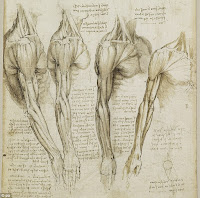
Da Vinci's Anatomical Drawings When I saw this week’s lecture title, the only person I could think of was Leonardo Da Vinci, and more specifically his drawing, the Vitruvian Man, comes to mind. However, outside of that it is hard to imagine a connection between medicine and art. So, I found this week’s lectures to be very surprising, especially regarding the history of medicine. Medicine in the modern society is so heavily reliant on technology, that it is hard to imagine that artists were the pioneers of the field. The artists mentioned in this week’s lecture were heavily involved in using the human body as a form of art. Although this form of art has come up in the past lectures, these artists really took it another level. A great example of this would be the Body World exhibition.  This art is definitely fascinating, but on some level I find it unsettling. Although the art is meant to celebrate the beauty of the complexity of the human anatomy, I f...